Tell us what happened
Answer a few short questions and tell your story from wherever you are. Your answers go straight to the team, and sending them commits you to nothing.

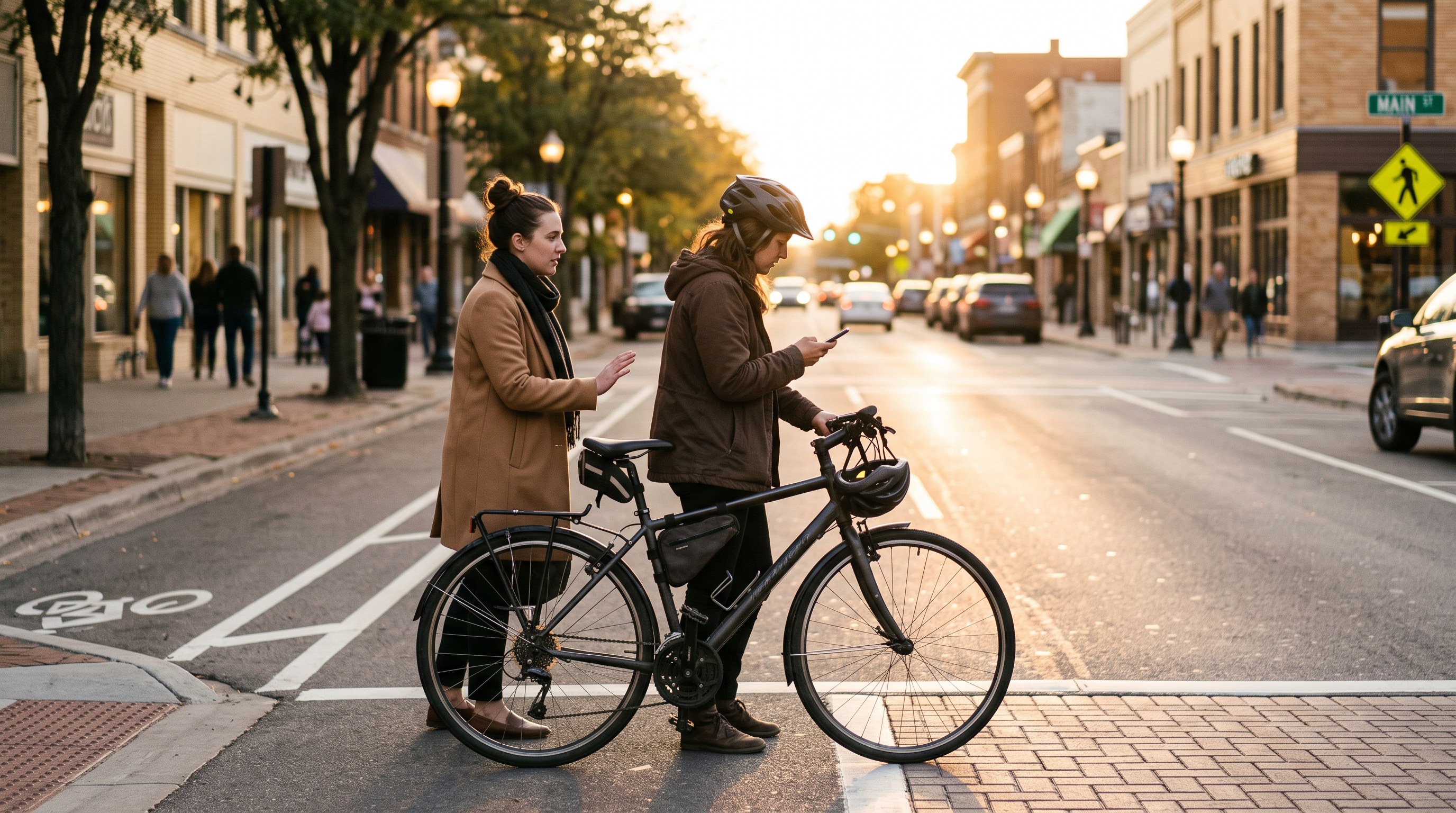
You are covered by auto no-fault even on foot. Here is how to claim it.
Most people go through this once, without a map. The numbers below are the official count, not our estimate. The rest of this guide is the map.
Source: Michigan Traffic Crash Facts, 2024 fact sheets.
Each phase protects the one after it. Get medical care fast, open the claim on time, build the record, then settle from strength.
Get medical care immediately, even for road rash and a sore wrist that might be broken. Report the crash to police if it was not reported at the scene. Photograph your injuries, your bike or gear, and the location. Keep everything unwashed and unrepaired. Then start your claim before any insurer calls you.
Benefits come first from your own household's auto policy if one exists, then down a priority chain, and if no policy exists anywhere, the Michigan Assigned Claims Plan is the backstop. Being uninsured yourself does not end your claim.
Drivers owe pedestrians and cyclists the duty everyone learned before the road test: yield, look, slow down. Insurers still argue that you darted out or rode against traffic, and comparative fault math is where these cases are fought. Where you were, which lane, which light, all of it matters, which is why week-one evidence matters. Michigan law treats young children differently on fault, and cases involving children get our most careful handling.
PIP benefits pay your medical care and lost wages. The driver's liability coverage pays for pain and suffering when your injuries cross the threshold, and a cyclist's injuries usually do.

Every injury claim in Michigan runs on clocks that start the day you are hurt. The forms are simple and the deadlines are unforgiving.
Time from the crash to each cutoff. Every case has facts that can shift these, which is exactly what a free first look confirms.
No formula survives contact with a real case, but the drivers are knowable. Economic damages are receipts and math. Pain and suffering is argued, not calculated, and multiplier rules of thumb are internet folklore.
Reported contributing factors, statewide. The other driver's behavior is often the heart of the fault argument.
Source: Michigan State Police 2024 year-end crash data.
Yes. If a motor vehicle hit you while you were walking or riding a bike in Michigan, auto no-fault covers you, even though you were not driving and even if you do not own a car. Most people never claim it.
Benefits come first from your own household's auto policy if one exists, then down a priority chain. If no policy exists anywhere, the Michigan Assigned Claims Plan is the backstop. Being uninsured yourself does not end your claim.
The driver's liability coverage pays for pain and suffering when your injuries cross Michigan's threshold, and a cyclist's injuries usually do. PIP benefits pay your medical care and lost wages regardless of fault.
Three Michigan Supreme Court decisions since 2024 changed what a pedestrian or cyclist faces after a crash. The newest, from March 2026, narrows a shortcut insurers were using against assigned claims. Seven rulings, newest first, on coverage, priority, and deadlines.
July 28, 2026
In March 2026 the Michigan Supreme Court told insurers they had been asking the wrong question about unlicensed drivers and the assigned claims plan. That is the third ruling since 2024 to move what a person on foot or on a bike faces after a crash. Coverage, priority, and deadlines all shifted. Below, newest first, are the seven rulings and what each one changed.
Michigan Supreme Court, decided March 10, 2026, Docket No. 166790 (read the opinion on CourtListener)
Carlonda Swoope borrowed a friend's car without asking. She had no license and no insurance of her own. A collision left her hurt, so she applied for personal protection insurance benefits through the Michigan Assigned Claims Plan, and the plan assigned her claim to Citizens. Citizens argued the claim was barred because she had taken the vehicle unlawfully and knew it.
The Court of Appeals threw the claim out on a different ground. It reasoned that because Swoope had no driver's license, she was operating the car unlawfully. A unanimous Supreme Court, in an opinion by Justice Bolden, said that mixed up two questions. Under MCL 500.3113(a), the statute asks whether the vehicle was taken unlawfully, not whether it was operated unlawfully. The Court reversed and sent the case back to decide the taking question.
For anyone whose claim runs through the assigned claims plan, this narrows a shortcut insurers had been reaching for. A driving offense at the moment of the crash does not answer the taking question. The court has to look at how possession of the vehicle was gained.
Michigan Supreme Court, decided July 3, 2025, Docket Nos. 165537, 165538, and 165964 (read the opinion on CourtListener)
Parie Wallace was hurt in a bus collision. Like a lot of injured people, she signed assignments of benefits so her medical providers could chase the bill. Then she filed her own lawsuit for those same benefits. The bus authority moved to end the case, arguing she had already given the claim away.
Justice Welch wrote for the Court. Wallace had standing, but she was not the real party in interest when she filed, because she had assigned the claims to her providers. That defect is serious. It is not always fatal. A plaintiff may be able to cure it by taking action inside the litigation, and only then does a court decide whether the fix relates back or whether the one-year-back rule cuts off recovery. Rescinding those assignments is not automatic either. Rescission is an equitable remedy a trial judge grants after weighing the equities.
Read what you sign at the clinic. A stack of intake paperwork can move the right to sue out of your hands, and untangling it later runs straight into a clock.
Michigan Supreme Court, decided June 11, 2024, Docket No. 165131 (read the opinion on CourtListener)
Charles Williamson was struck by a car. He had no auto insurance, so he applied to the Michigan Automobile Insurance Placement Facility, which runs the assigned claims plan. His claim went to AAA. AAA refused to pay. Williamson died while the case was pending, and his daughters carried it forward as co-personal representatives. In answers to written questions during discovery, the estate claimed attendant care benefits for services said to have been provided after he died.
The Court of Appeals had held that statements made in discovery can never be fraudulent insurance acts. A unanimous Supreme Court, in an opinion by Justice Welch, reversed. Under MCL 500.3173a(4), a false statement is a fraudulent insurance act when it supports a claim to the placement facility or to the insurer the plan assigned. Discovery answers filed after a lawsuit starts can qualify, and a claim supported by a fraudulent insurance act is ineligible for benefits under the plan.
The point is narrow and heavy. In an assigned claims case, every document counts, including the ones filed months into litigation.
Michigan Supreme Court, decided July 15, 2022, Docket No. 162419 (read the opinion on CourtListener)
A truck merged into Willie Griffin's lane. He swerved, his motorcycle went down, and he was badly hurt. Nothing touched him. The officer wrote down the truck driver's name, phone number, and home address, but not the plate, the VIN, the owner, or the insurer. Griffin hired a lawyer, wrote to the driver, and filed a claim with his own insurer. Nobody found the truck's insurer until discovery, and by then the one-year period had run.
Justice Welch wrote for the majority. MCL 500.3114 puts the job of claiming benefits on the injured person, and claiming means putting insurers on notice and asking for payment. Diligence is required, and whether someone was diligent is decided case by case. Insurers carry duties too. The Court said the statute pushes insurers to pay first and seek reimbursement later, and that an insurer confident it is not on the hook should deny promptly so the claimant can go to the placement facility. Griffin acted diligently. Because the higher-priority insurer could not be identified before suit, his own insurer stood as the default. Justices Zahra and Viviano dissented.
For a pedestrian or cyclist, the order of insurers is a sequence, not a guess. Griffin says courts look at what you actually did to find the right one.
Michigan Supreme Court, decided July 31, 2010, 487 Mich 180; 795 NW2d 517 (read the opinion on CourtListener)
Rodney McCormick was on foot at a General Motors plant when a coworker backed a truck into him and drove over his left ankle. He broke the bone, had hardware surgically installed, went through months of therapy, had a second surgery, and returned to work nineteen months later.
The Court held that Kreiner v Fischer was wrongly decided because it departed from the plain language of MCL 500.3135, and overruled it. Justice Cavanagh's opinion then held that McCormick had suffered a serious impairment of body function as a matter of law.
Benefits and lawsuits are two different tracks. To pursue pain and suffering from the driver, an injured person has to clear the serious impairment threshold, and McCormick is the reading courts apply. How a jury later divides fault between the people involved is a separate fight that turns on the facts of each crash.
Michigan Supreme Court, decided July 14, 1998, 458 Mich 214; 580 NW2d 424 (read the opinion on CourtListener)
Francis McKenzie fell asleep in a camper trailer hitched to his pickup and was asphyxiated. He survived and sought no-fault benefits. Justice Taylor wrote that the injury was not covered, because the act reaches injuries arising out of the use of a motor vehicle as a motor vehicle, which the Court tied to the vehicle's transportational function. Justice Cavanagh dissented.
That phrase does real work in coverage fights. A person struck by a moving car in a crosswalk sits comfortably inside it. The harder cases sit at the edges, where a vehicle is parked, loading, or doing something other than carrying people.
Michigan Supreme Court, decided June 20, 1995, 449 Mich 33; 534 NW2d 665 (read the opinion on CourtListener)
Marisa DeMeglio was twelve, visiting her grandparents in Oakland Township, when a car hit her bicycle. She lived in Pennsylvania. Her parents carried a Pennsylvania policy and had no Michigan no-fault coverage, and Michigan law did not require them to.
Chief Justice Brickley laid out the rule that governs most people on foot and on bikes. Under MCL 500.3115(1)(a), someone hurt in an accident involving a motor vehicle while not an occupant, who does not own and is not required to own Michigan no-fault insurance, claims benefits from the insurers of the owners or registrants of the vehicles involved. The insurer of the car that hit her was responsible. The Court then held that benefits her parents' out-of-state policy was required by law to pay counted under MCL 500.3109(1) and could be subtracted from what the Michigan insurer owed.
Two lessons for a cyclist with no car of their own. The driver's insurer is where the claim starts. Other coverage you already carry can change the math.
None of this tells you what your claim is worth or how it ends. It tells you which questions courts are asking. If a car hit you or someone in your family while you were walking or riding, call 844-ASK-AZZO (844-275-2996). Our intake team takes your information and routes your question to the right person at the firm. No pressure, and no charge to ask.
Lauren Sitto Azzo, lead attorney at Azzo Law, PLLC, is responsible for the content of this page. This section is general information about Michigan court decisions and not legal advice, and reading it does not create an attorney-client relationship.
No pressure. Tell us what happened, and a real person calls you back. If your case is not worth pursuing, we say so and tell you what to do instead.
Tell us what happenedOr call 844-ASK-AZZO (844-275-2996) · Free consultation, no fee unless we win
We use cookies that make this site work. Accept also turns on our live chat and the Google tools that measure how people use this site and how our advertising performs. Essential only keeps all of those off. Our Privacy Policy has the detail.


